
Waste-to-Energy Dissolution Means Good Things for Ames
Updated: Jan 1
Jump to:
Overview
The City’s decision to dissolve our current Waste-to-Energy (WTE) system effective July 2027 will bring overwhelmingly positive things to residents. Yet, understandably, this change brings an element of uncertainty to the community. The Ames Climate Action Team has been following these developments, advocating for them, and is here to help our fellow residents understand them.
The WTE system is outdated and no longer competes with more affordable, alternative energy sources such as wind, solar, and purchasing directly from the marketplace (Iowa is part of the Midcontinent Independent System Operator [MISO] network). WTE creates GHG emissions (including unmonitored emissions related to the burning of plastics) at a rate that does not align with the City’s ambitious target to reduce emissions by 83% by 2030. Lastly, the WTE system is subsidized by electric rate payers who also pay for their waste stream through curbside hauling, resulting in double-dipping rate payers.
Background
In 1975, Ames commissioned the Arnold O. Chantland Resource Recovery Plant (RRP) to meet the needs of not only handling waste, but also creating a cleaner municipal-owned source of electric energy. Prior to this facility, Ames had been using solely coal to generate electricity. With the creation of the RRP, the City aspired to reduce its emissions, and its consumption of coal, by incorporating another source of fuel, Refuse-Derived Fuel (RDF) generated from the City’s waste stream. The benefits were two-fold, as the WTE system also reduced the amount of waste sent to a rapid-filling landfill. Ames’ RRP is the first of its kind and we’ve long been proud of this fact. Over its lifetime, the RRP has allowed for electric generation to be fueled by, at times, up to 50% of RDF, significantly reducing emissions from burning coal. While considered sustainable and innovative for its time, the RRP has served the community reliably until on-going maintenance costs and greenhouse gas (GHG) emissions were realized.
Change to Natural Gas
In 2016, the RRP was converted from coal-powered incineration to natural gas. While this switch was championed as a 40% reduction in our overall carbon footprint, it created unforeseen challenges and cost implications. The boilers were designed to burn coal with RDF, not just RDF. The on-going costs of burning natural gas coupled with the dwarfing ratio of 90% natural gas to 10% RDF ratio (per environmental permitting) to create only a mere 3.55% of our overall electricity generation from RDF (not natural gas) has trapped the City and its rate-payers into a forced and inefficient model. In 2025, natural gas made for up more than 20% of the utility’s budget–$17.6 million. The City has already utilized $10.6 of its budget to cover natural gas through the end of 2025 which means just $7 million remains budgeted to finish out the fiscal year. If the City goes over its budget, residents will be on the hook for costs through “energy cost adjustments” in their monthly electrical bills.
Increased Plastics in Waste Stream
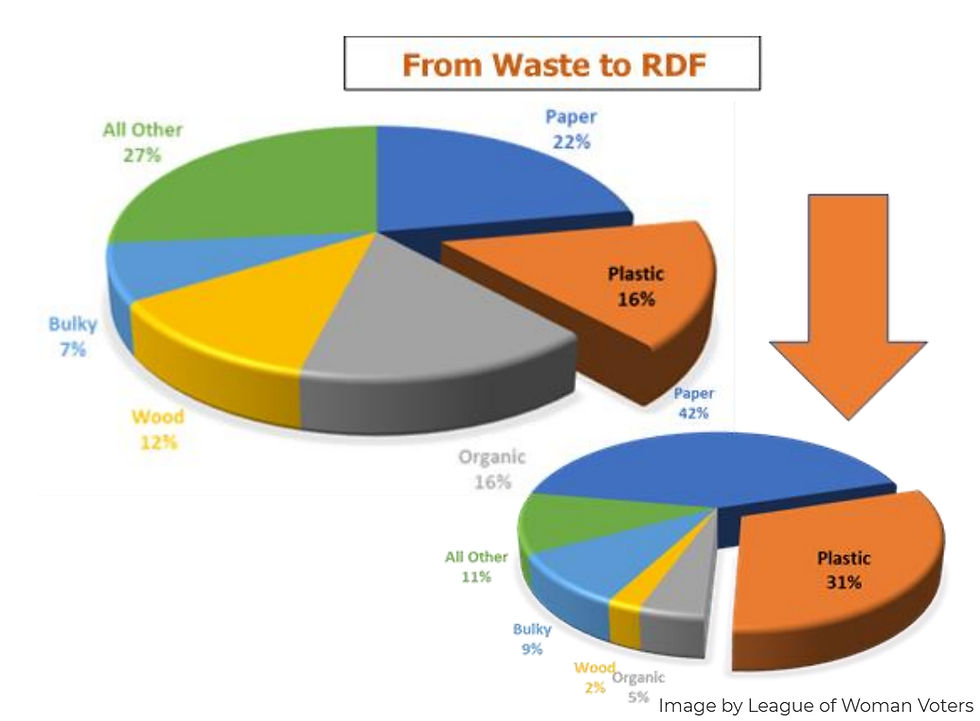
Data collected in 2021, show plastic waste made up 16% of the overall waste stream compared to just 1% in 1975. The increase in plastic waste has created a number of problems for the WTE system. Once the waste stream has been sorted and appropriately recycled before becoming RDF, plastic becomes an even larger share at 31%. Incinerating plastic creates gaseous chlorine compounds that corrode and destroy boiler tubes. The total cost of corrosion problems due to burning waste has exceeded $15 million. In 2024, the utility purchased $17 million in natural gas to power generators that would only run to burn waste. This resulted in 217,000 tons of GHG emissions. If Ames had instead purchased electricity at market rate from MISO instead, we would have reduced GHG emissions by 114,000 tons (47%).
Where waste incineration solves a problem (reducing the amount of waste to be landfilled), it creates others. Incineration immediately releases GHGs whereas landfilled materials do not readily break down and thus release GHGs slowly over time. Furthermore, the incineration of plastics is not appropriately monitored. The City has generalized the monitoring of emissions (per permitting standards) but lacks the capacity to monitor the exact compounds released from incineration–leaving the community at risk of exposure to harmful chemical compounds such as Persistent Bioaccumulative Toxins (PBTs) that increase long-term health risks for respiratory problems, cancers, birth defects, developmental abnormalities and other health problems.
Burning Waste Isn’t “Green”
Over the past ten years, the city has been quickly approaching a crossroads; faced with the decision of whether to continue course–replacing the boilers with more robust and corrosion resistant ones to maintain our current system–or alter course to coincide with the changing climate, costs, and waste stream. The RRP being tied to our electric utility has encouraged the production of waste (to be landfilled regardless) instead of incentivizing residents to decrease their waste (to avoid being landfilled altogether). The City has irrevocably disincentivized recycling for many, many years by defaulting to the RRP to handle sorting out recyclables. We’ve heard residents say, “I don’t need to recycle because the city recycles out of my trash”. While true, the RRP will sort and recycle certain materials, this widely accepted rhetoric coupled with slogans such as “your trash powers our city” have led to the unintentional reliance on a system that does not encourage reducing waste output and does not serve the health and livelihoods of its residents.
Landfilling.. Friend or Foe?
Typically, when we think about the human impact of consumption in relation to the environment, we think about landfills. This is understandable given the visual eye sores that they are (beyond the negative environmental issues that can be attributed to them). The reality is that we have been far removed from realizing our own impact on the environment because the WTE system has given us a sense of environmental sustainability. We “recycle waste” by creating RDF but we’ve always relied on landfilling. After incineration, we send the ash leftover with the rest of the waste stream to landfills, out of view from our neighborhoods. The WTE system has given us a sense of redemption for our growing level of consumption. With the dissolution of WTE, our landfill utilization will be greater as ash takes up less space in a landfill than unburned solid waste does.
Despite these changes that come from dissolving the WTE system and our existing preconceptions about landfills, landfilling our waste stream and putting an end to incineration is the best step forward. Landfilling allows waste to break down slowly and release GHG emissions over time as opposed to releasing them immediately through incineration. Ames has partnered with Carroll County to landfill the portion of our waste that cannot be reused or recycled. Carroll County has shown alignment with our climate goals by utilizing electric-powered equipment at the landfill in addition to submitting a Request for Proposals (RFP) to implement carbon capture technology.
While the potential for a reduction in GHG emissions through carbon capture to create recycled natural gas as an energy source to be sold is promising, the order of operations still stands; reduce, reuse, then recycle. About 58% of methane gas emissions from municipal solid waste landfills can be attributed to landfilled food waste. This highlights the importance of food waste diversion (the City does accept food waste to be composted at RRP) in addition to reducing our household consumption contributing to the waste stream.
Are We Still Recycling Waste?

The City is not ending resource recovery, but will replace the existing facility with a larger transfer station (waste sorting facility) that will be utilized to continue to sort, store, and recycle materials that can be diverted from landfilling. From this transfer station, separated and collated material streams will either be sold (money back to the city) or compacted, stored, then shipped to Carroll County’s landfill. This transfer station will generate additional revenue given its larger capacity to process and sort the waste stream. It will also expand and improve its current drop-off recycling program at the facility to be more user-friendly (parking and access improvements). The City currently offers (and will continue to offer) drop-off recycling for the following materials: cardboard, mixed paper, metal, glass, clothes/shoes, and food waste.
Concerns Around Community Choice
Many residents in the City have appreciated the ability to choose their hauler and monthly rate as it relates to waste. Some residents say that they support curbside recycling but want to choose their hauler. Previously, curbside recycling has been an opt-in service available for residents through a few of the private haulers. With the dissolution of the WTE system, the City recognizes their responsibility in promoting recycling and has committed itself to rolling out municipally-owned curbside recycling. While the specifics are still to be negotiated, we do know that the City will choose one hauler to handle this service and it will begin July 2026. Every household in Ames will be given a 96-gallon rollaway container to be picked up bi-weekly. Every household will be charged $6-8/month for this service (added to residential electric bills).
This will not impact waste hauling at this time, however, these changes bring a valid point to be considered which is both the cost-savings and emissions-savings realized with a one-hauler system. The current free market system in the City to manage its waste hauling creates costly wear-and-tear on residential streets and greater GHG emissions as compared to a single-hauler or regional single-hauler system. Roadway upkeep–the manufacturing and use of concrete and asphalt–are responsible for around 30% of overall US GHG emissions. Ames currently has seven permitted waste haulers. This means that every week there’s seven large garbage trucks utilizing our roadways and creating seven times the damage to our roads than necessary. One loaded garbage truck passing along a street does as much damage as 1000-1500 cars. Even taking into account 50 delivery trucks per week, garbage trucks still account for 90% of the wear and tear.
The City, and its residents, would be wise to consider both the cost-savings and emissions-savings to switching to a single-hauler or regional hauler (Ames is divided up into regions and allows for one hauler assigned per region) in the future. The current free market waste-hauling system benefits residents so long as they don’t understand the realized costs passed on to them through road improvements and adverse health outcomes related to increased GHG emissions. ACAT encourages and supports a regional or city-wide single hauler waste system and it is our hope that the City and its residents will realize the benefits of adopting this system sooner rather than later–especially with the related changes to the WTE system.
Future Plans
With the City landfilling 100% of its waste stream that is not diverted, they are likely to shift their rhetoric to something more aligned with “less is more”. The City has committed to a municipal-owned single-stream curbside recycling program to be rolled out summer 2026. This move is long overdue and is an important step in reducing the amount of waste sent to be landfilled. The amount of waste created will be scrutinized to a greater degree and thus, residents will need to be mindful of their waste output. The new transfer station, slated to open July 2027, will continue to provide “drop-off” recycling to residents to encourage and increase resident recycling and the reduction in residential waste output.
The dissolution of the WTE system cannot come soon enough. While ACAT applauds the City’s decision to replace the WTE system with one that’s more sustainable and cost-effective, we believe there are still changes to be made right now–moving contracts forward to install Reciprocating Internal Combustion Engines (RICE) units to create electric power generation, adopting a regional or single-hauler curbside waste hauler system, and prioritizing landfilling waste prior to July 2027 by considering other alternative landfills if Carroll County is unwilling to accept our waste interim.


Comments